The purpose of this page is to provide factual information about Amherst Schools' current financial outlook, the district's budget reductions, and the November 3, 2026 operating levy. It will be updated periodically as new information becomes available.
1. What will be on the November ballot for Amherst Schools?
The Amherst Board of Education is placing a 5.97 mill fixed-rate property tax levy on the November 3rd ballot to provide the district with funding to maintain day-to-day operations. This levy request equates to $209 for each $100,000 of the county auditor's market value...or under $18 per month.
It will be the district’s third attempt at asking the Amherst community for additional operation revenue in the past year. The last new operations levy was passed in 2012.
2. What is the difference between the upcoming November 2026 ballot issue and the ballot issues from November 2025 and May 2026?
The November 2025 ballot Issue 16 was a request for a 1.5% earned school district income tax to provide the school district with $10 million for operations. The May 2026 ballot Issue 1 was a request for a 0.75% earned school income tax to provide the school district with $5.8 million for operations. The November 2026 ballot issue will be a request for a fixed-rate 5.97 mill property tax levy to provide the school district with $5.8 million for operations.
3. Why did the Board switch from an earned school district income tax to a fixed-rate property tax levy?
The Amherst Board of Education changed the funding mechanism after carefully reviewing community feedback from the November 2025 and May 2026 levy elections. While the district’s financial needs remain unchanged, many residents expressed concerns with the earned income tax structure and indicated they preferred a more traditional property tax levy.
The Board selected a fixed-rate property tax levy for several reasons:
Many residents feel a property tax is easier to budget and plan for financially since it's often included in mortgage or escrow payments rather than deducted from every paycheck.
Under Ohio House Bill 920, voted property tax levies do not automatically increase as property values rise. In contrast, income tax collections increase as residents’ earnings increase over time.
A property tax spreads the financial responsibility more broadly across the community at the household/property level rather than taxing every individual wage earner in the home, including students with part-time jobs.
The proposed levy generates approximately the same annual operating revenue requested in May 2026 and is intended to help maintain educational programs, staffing, transportation, student services, and daily operations.
The Board remains committed to responsible stewardship of taxpayer dollars while balancing the financial needs of the district with the community’s feedback and preferences.
The Board believes this revised approach provides a funding structure that is more familiar, transparent, and manageable for many residents while continuing to address the district’s ongoing operational needs.
4. How was the district able to reduce the levy from $10 million in November to $5 million in May?
ACTION STEP #1 - Reduction Plan
After the November levy failed, Amherst was placed in “Fiscal Precaution” by the Ohio Department of Education & Workforce due to projected operating deficits in our financial forecast. As a result, the district worked with ODEW to develop and implement a multi-year expenditure reduction plan required to eliminate the deficit. The ODEW Precautionary Plan requires total expenditure reductions of $13,264,733 between FY2026 and FY2029. This plan was approved by the Board of Education on December 15, 2026 and approved by ODEW on January 6, 2026.
ACTION STEP #2 - Negotiations
The Amherst Administrative Team, the Amherst Teachers Association (ATA), and the Ohio Association or Public School Employees Local #208 (OAPSE) reached tentative agreements on one-year labor agreements for the 2026–2027 school year. Under the terms of the agreement, administrators, teachers, and classified staff will receive a 0% increase on base salary for the 2026–2027 school year.
The Board of Education, Administrative Team, Amherst Teachers Association (ATA), and Ohio Association of Public School Employees Local #208 (OAPSE) are working collaboratively to avoid further financial burden on the community while maintaining staffing stability as much as possible.
5. What were the expenditure cuts after the November levy failed?
In order to reduce expenditures by over $13 million, the district made devastating cuts to staffing and operations. Below are the FY26-FY29 reductions approved on February 23, 2026:
NON-PERSONNEL REDUCTIONS
Steele News Live Program
French Program
AJH Homemaking & Consumer Education Program
High School Busing (9-12)
$1 Million Reduction in Textbooks and Curriculum
18 Instructional Software Programs
Professional Development Programs
General Supplies and Programs
PERSONNEL REDUCTIONS (48 Positions)
1 Buildings and Grounds Supervisor
1 Special Education Coordinator
1 Social Worker Position
1 School Counselor Position
3 Spanish Positions
1 French Position
2 Science Positions
1 Steele News Live Position
1 Homemaking Consumer Ed Position
2 English/Language Arts Position (7-12)
1 Music Position
2 Technology Innovation Specialists
2 Literacy Coaches
2 Intervention Specialist Positions
1 Fifth Grade Positions
2 Fourth Grade Positions
2 Third Grade Positions
2 First Grade Positions
4 Bus Aide Positions
4 Bus Driver Positions
3 Part-Time Cleaners
4 Full-Time Cleaners
4 Monitors
1 Assistant Mechanic
6. If a future levy passes, will these cuts return?
MAYBE. Currently, the revenue collected from a future operating levy will only balance the budget enough to maintain the current reduced staff levels and eliminated programming, bussing, etc. The answer to this questions depends solely on the next biennium budget.
If the Ohio legislature and next Governor decide to increase Amherst's state funding, or if they implement the Fair School Funding Plan properly, then there is a chance that we can bring back some of the previous cuts. If the legislature freezes Amherst's current state funding or reduces our funding again, then previous cuts will not return. Unless the State of Ohio funds public schools appropriately, the district will either maintain the reduced staffing levels and programming through new local revenue or we will need more future cuts.
7. If a future levy fails, will there be more cuts?
YES. Even with the reductions already implemented, the district still projects operating deficits in the coming years. Without new revenue, programming, staffing, and support services will continue to face cuts. Unless the State of Ohio funds public schools appropriately, the district only has two choices to maintain current operations - new local revenue or continuing expenditure cuts.
8. How is the Amherst Exempted Village School District financed?
The majority of Amherst’s funding comes from local revenue. Amherst receives 43% of its funding from local taxes. Amherst receives an additional 39% of its funding from the State of Ohio, 11% from the federal government, and 7% from other revenue.
9. Is the State of Ohio providing enough revenue and support for Amherst?
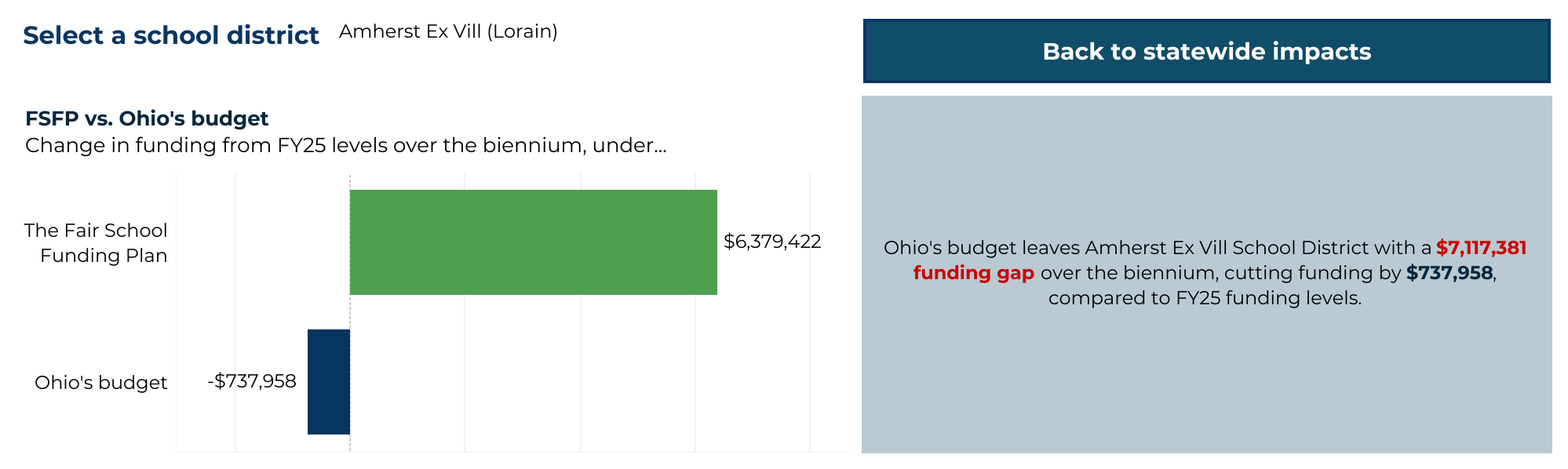
NO. The state legislature’s decision to abandon the Fair School Funding Plan (FSFP) in the last biennium budget is forcing massive operational cuts and shifting the tax burden onto local residents. Ohio's public schools are facing an estimated $2.7 billion funding shortfall.
According to Policy Matters Ohio, the Amherst Exempted Village School District lost $7,117,381 in state revenue during this two year biennium budget!
10. How much revenue is the State of Ohio giving Amherst?
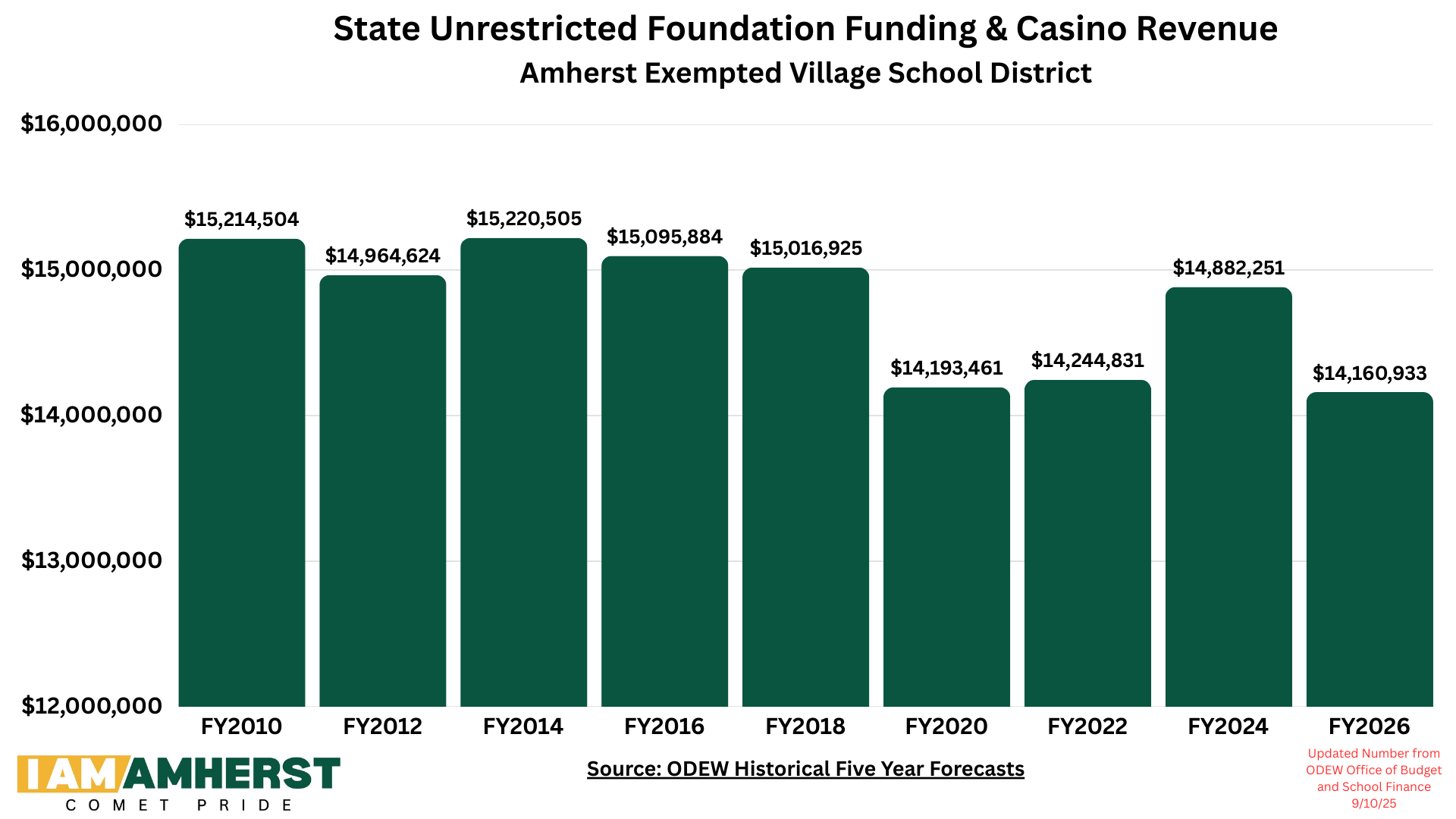
In FY2025, Amherst received $14,755,730 in state unrestricted foundation funding plus casino revenue from the State of Ohio to help fund our school district. In FY2026, Amherst is projected to only receive $14,160,933 in state unrestricted and casino funding - a reduction of about $600,000 dollars in one year. To provide context, in 2010, Amherst received $15,214,504 in state foundation funding. For the last 15 years, the State of Ohio’s foundation funding for the Amherst Exempted Village School District has steadily declined. Please see the graph below for more details.
11. How does Amherst compare to other school districts in regards to revenue?
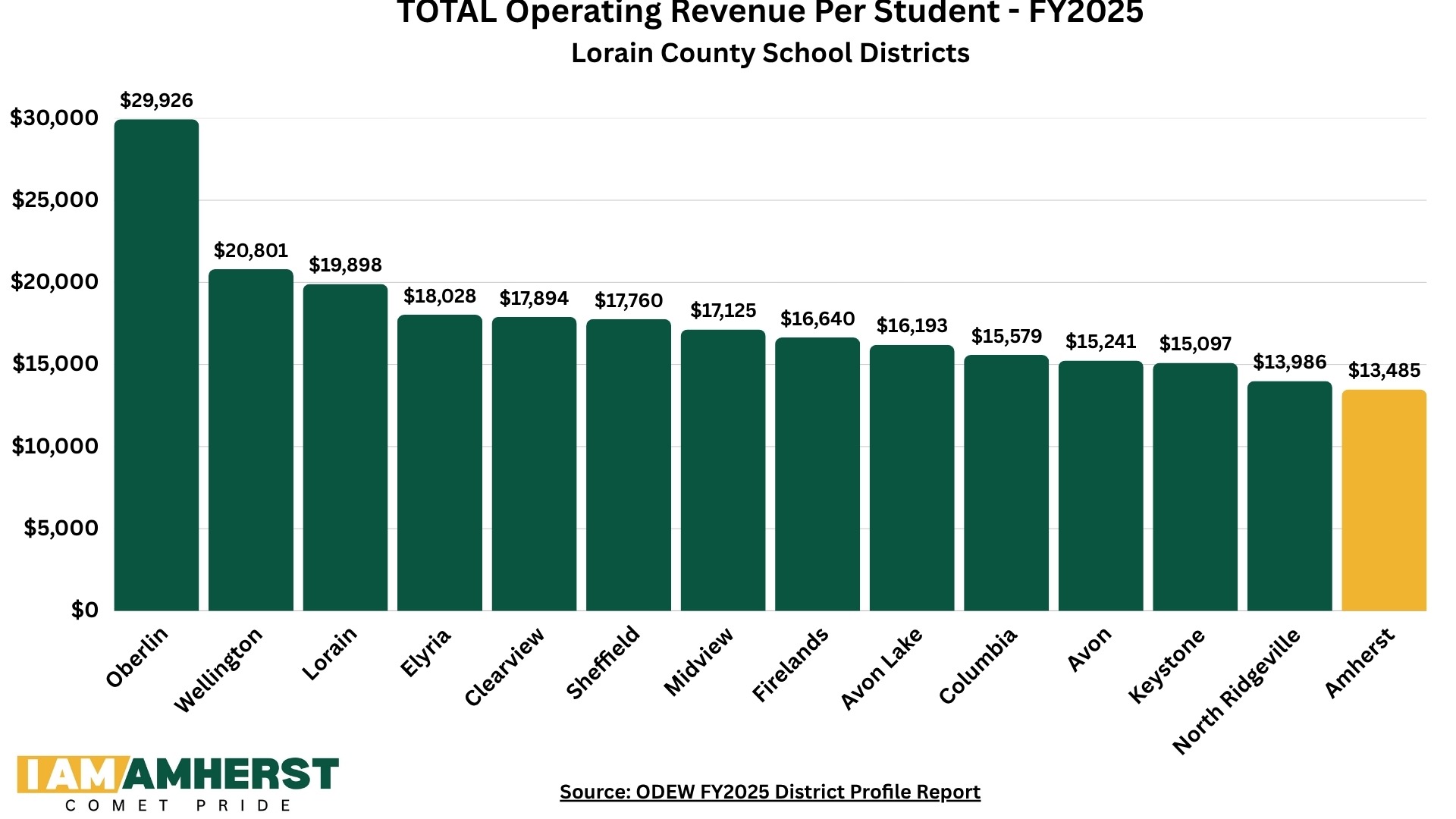
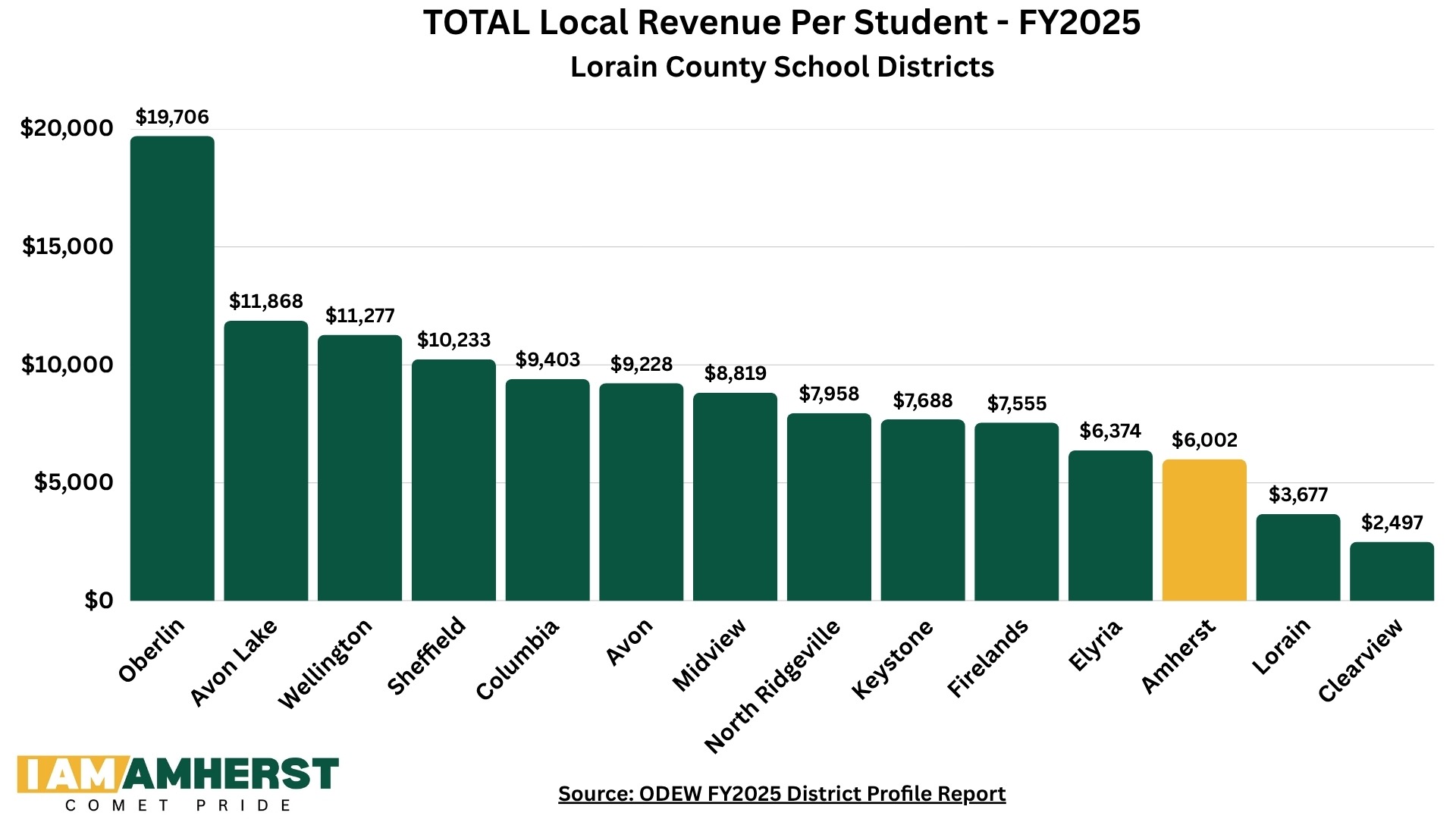
In 2025, Amherst received $6,002 per student from local revenue and $5,687 per student from state revenue. Amherst received $13,485 per student in total revenue which is the lowest amount in Lorain County and the ninth lowest amount in the State of Ohio. Out of 606 school districts in Ohio, the Amherst Exempted Village School District ranks 598th in total revenue per student. For comparison, Amherst received $13,485 per student, the state average was $18,352 per student, and the Ohio school district with the highest revenue received $47,825 per student. Please see the graphs below for more cdetails.
12. How does Amherst compare to other school districts in regards to expenditures?
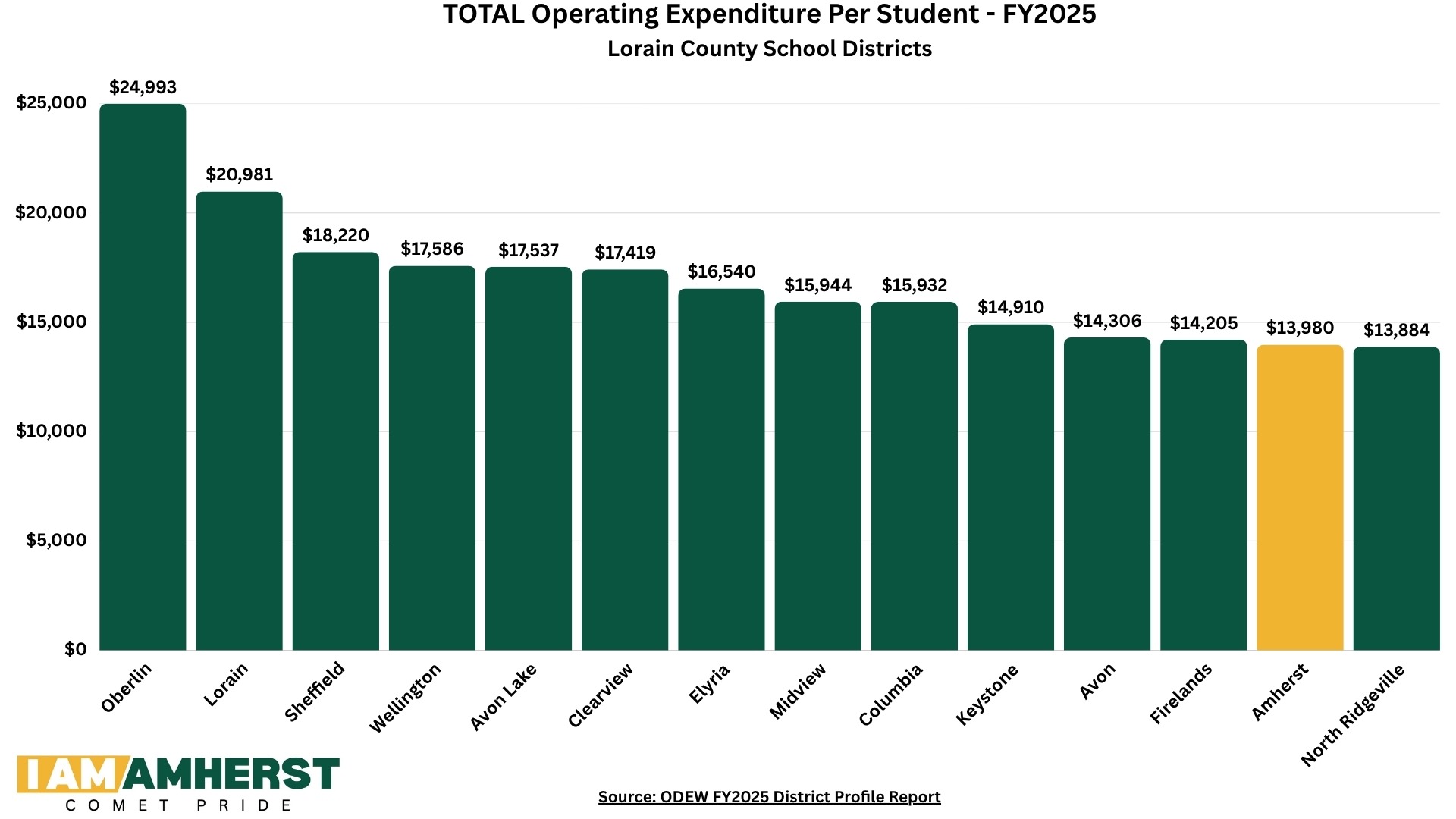
In 2025, Amherst spent $13,980 per student in total expenditures which is the second lowest amount in Lorain County. Out of 606 school districts in Ohio, the Amherst Exempted Village School District ranks 540th in total expenditures per student. For comparison, Amherst spent $13,980 per student, the state average was $17,609 per student, and the Ohio school district with the highest expenditures spent $40,716 per student. Please see the graph below for more details.
13. There is a current lawsuit regarding vouchers being unconstitutional. How is the expanded voucher program hurting the Amherst Schools?
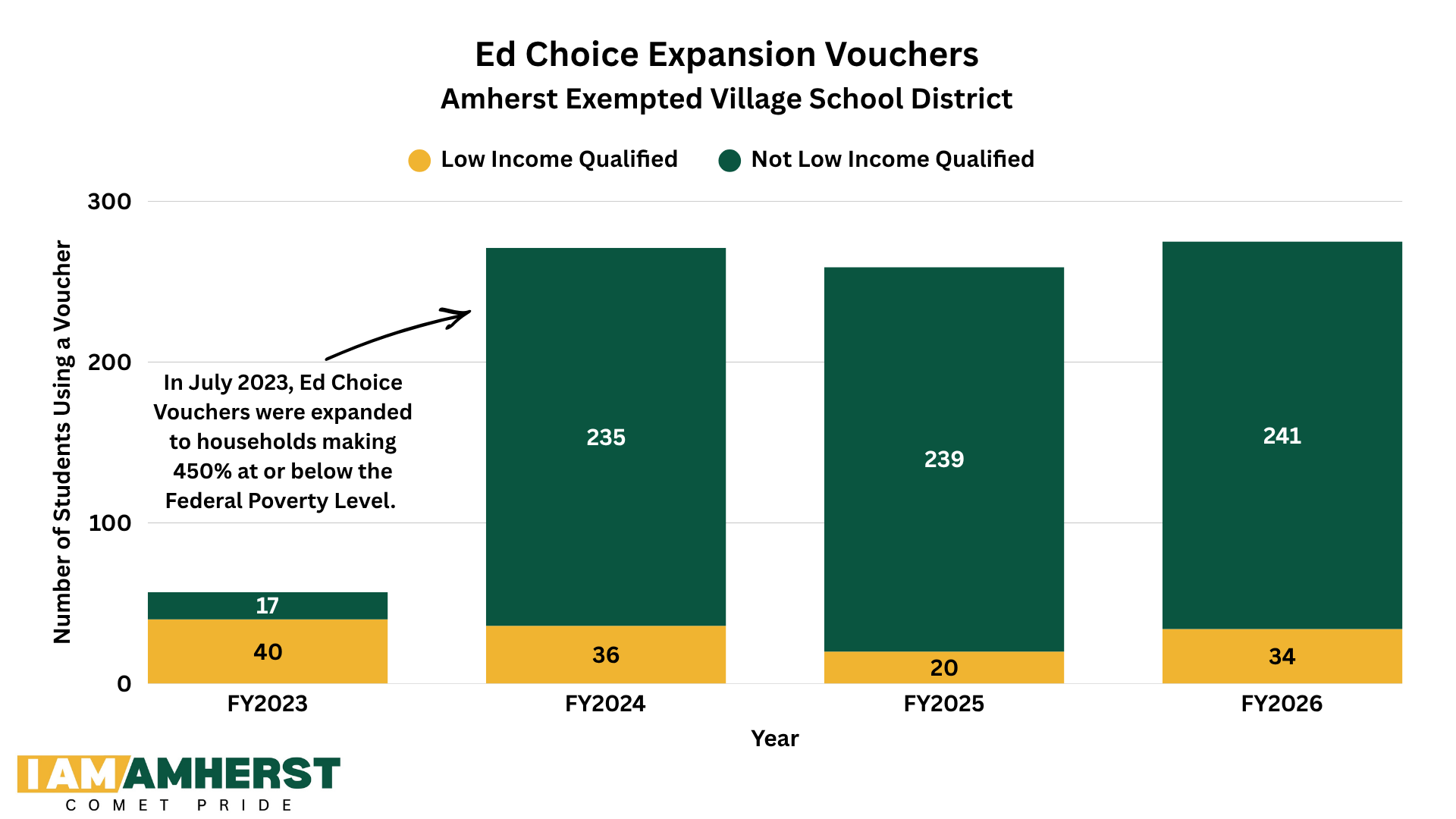
Ohio has significantly expanded its EdChoice Expansion Scholarship Program, which provides public funds to help families pay tuition at participating private schools. Under the program, families with household incomes at or below 450% of the Federal Poverty Level qualify for the full scholarship amount. For context, a family of four earning approximately $144,675 qualifies for the full scholarship at that income threshold.
In FY26, 275 Amherst resident students were reported as receiving EdChoice Expansion scholarships. Almost 88% of those students were NOT low-income qualifying students. The average EdChoice Expansion scholarship in Lorain County in FY25 was approximately $4,775. Applying that average to 275 students represents an estimated $1.31 million in public funds supporting private school scholarships for Amherst resident students.
This estimate is not a direct reduction of $1.31 million in state foundation payments to Amherst Schools. Rather, it illustrates the scale of public funding being directed to private-school scholarships instead of being available to support public education. If this $1.31 million were given to the Amherst Schools, it could reduce the amount of additional local revenue the district would need to support its operations.
14. Does the district ever seek additional revenue to offset expenditures?
YES. Over the last three years, the district has used almost $4 million in COVID relief grants to offset costs in personnel, supplies, technology, and purchased services. Amherst was the only school district in the state of Ohio to receive both the Comprehensive Literacy State Development grant worth $270,000 and the Each Child Reads grant worth $67,233 in the last three years. Amherst also received a competitive $1.6 million Ohio Career Technical Equipment grant to fund our state-of-the-art Robotics and Advanced Manufacturing program at Marion L. Steele High School. In addition to competitive grants, the Amherst Exempted Village School District also works with business partners, community partners, and private citizens to help fund special projects and initiatives through public and private donations. Recently, the Amherst Schools have received a $160,000 private donation to support the track renovation, $40,000 from the Amherst Schools Educational Foundation (ASEF) to create a new Comet Corner store, $25,000 from ASEF to fund a new Business & Entrepreneurship teacher, and recently signed a ten-year agreement with Spitzer Autoworld Amherst worth $25,000 per year for stadium naming rights (Spitzer Stadium). The Amherst Schools work very hard to find alternate revenue streams to offset costs!
15. Will new homes and previous communities with ending tax abatements provide more revenue in the future?
Yes. It is very difficult to predict the revenue from new homes but a new $250,000 home would generate about $2,000 of new tax revenue to the school district. Each new home can also bring new Amherst students which adds to our expenditures. As for homes with tax abatements, the City of Lorain has provided us a list of abated homes and their abatement schedule. Over the course of the next five years, we’ve identified 89 homes which will start providing school revenue. The total revenue from those 89 homes is about $81,000 per year once all 89 homes are in full collection by FY 2030.
16. Doesn't the Ohio Lottery help fund public schools in Ohio?
According to the Ohio Legislative Service Commission, lottery profits have never accounted for more than 17 percent of total state spending on education since its inception, and recently it has been around 12 percent. In practical terms, this means nearly 90 percent of state spending on schools comes from primarily income and sales taxes deposited into the General Revenue Fund.
Also, lottery profits are woven into the budget rather than stacked on top of it. For example, if lottery profits come in at $1.45 billion, that reduces the amount the state must draw from general tax revenue to reach its target. It does not automatically add $1.45 billion in new spending above and beyond what lawmakers have allocated for public education.
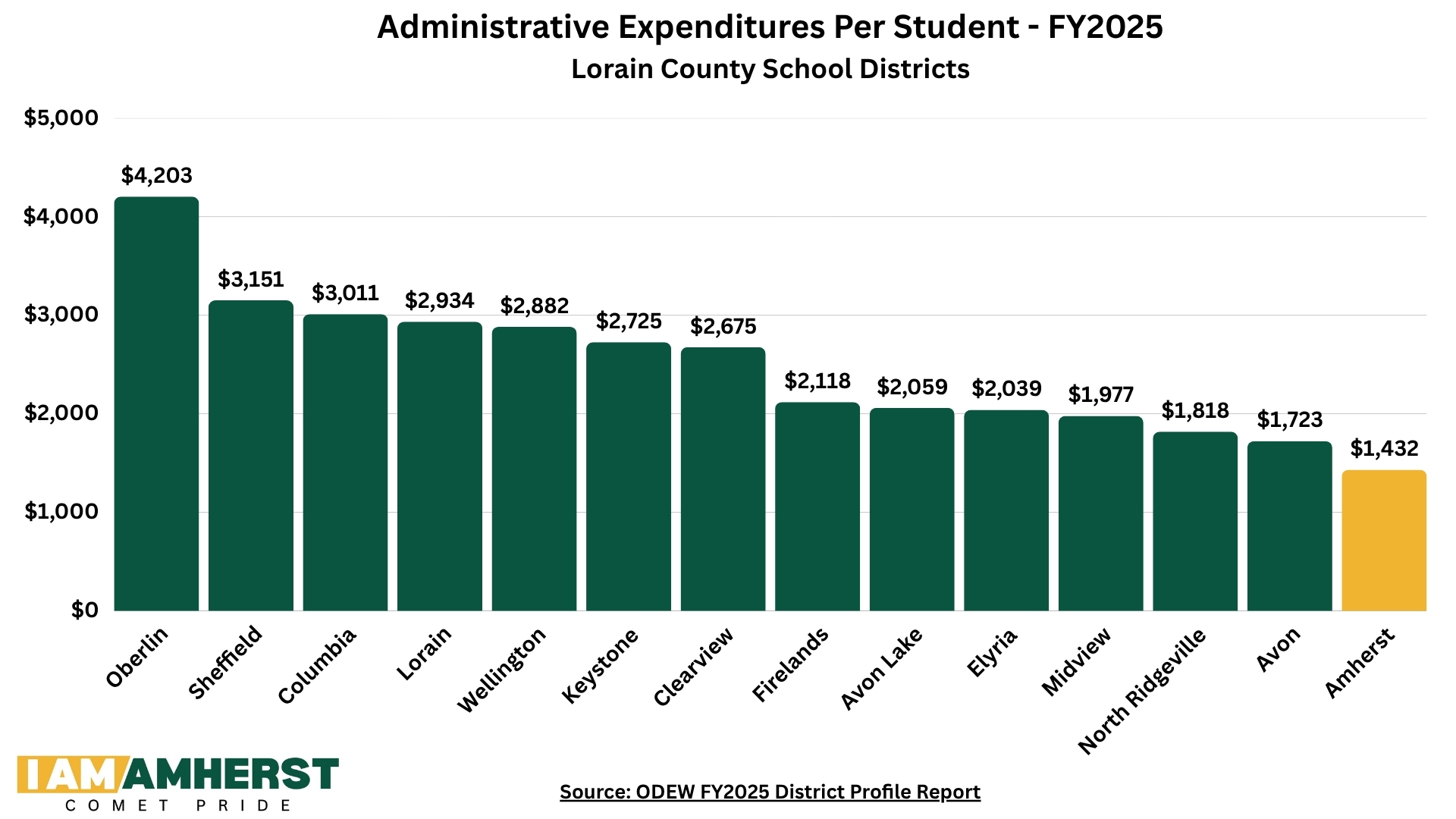
17. How does Amherst compare to other Ohio school districts in regards to administrative expenditures?
In 2025, Amherst spent $1,432 per student in total administrative expenditures which is the lowest amount in Lorain County. Out of 606 school districts in Ohio, the Amherst Exempted Village School District ranks 588th in administrative expenditures per student. For comparison, Amherst spent $1,432 per student, the state average was $2,328 per student. Please see the graph below for more details.
18. Why did the district choose to build the transportation center and renovate the stadium before passing an operating levy?
These projects were part of a long-term facilities and financial plan developed with community input and not an attempt to prioritize athletics or facilities over classroom instruction. In 2022–2023, the district evaluated three significant financial challenges: deteriorating exterior facilities, aging school buildings, and the eventual need for additional operating revenue. The goal was to address these needs in a responsible order while minimizing the burden on taxpayers.
1. We developed a long-term plan with community input.
In 2022, the district recognized that several major needs would require substantial investment over the following decade. The bus garage was in serious disrepair, and buses were being stored outdoors, exposing them to the elements and potentially shortening their useful lives. The stadium was approximately 50 years old, with deteriorating bleachers, and the track, tennis courts, fences, and other exterior facilities needed to be replaced.
At the same time, several school buildings had aging roofs, heating and cooling systems, boilers, flooring, and other infrastructure concerns. Although Powers Elementary School was relatively new and the Amherst Junior High was about 20 years old, Marion L. Steele High School and Walter G. Nord School were much older and faced substantial facility needs.
The district also knew that additional operating revenue would eventually be necessary. In 2022, however, the district had approximately $21 million in cash reserves, and the state had begun implementing the Fair School Funding Plan. Based on the financial information available at the time, the district anticipated that an operating levy might be needed sometime between 2025 and 2030, depending on state funding and the growth of expenditures.
To understand community priorities, the district conducted a community survey in December 2022. Residents identified facilities as an important concern, particularly the condition of Marion L. Steele High School, Walter G. Nord School, and the athletic and performance facilities. In response, the district formed a Facility Advisory Committee (FAC), which met from January through May 2023 to examine the district's needs, costs, funding opportunities, and priorities including the long-term cost of operations.
2. The committee recommended addressing the needs in a deliberate sequence.
The district faced three major financial challenges, each with a different funding strategy and timeline:
Exterior facilities: Address the deteriorating transportation facilities and stadium first, using a Permanent Improvement levy. (2-4 years)
Daily operations: Seek additional operating revenue when financial projections showed it was needed to sustain educational programs and services. (3-7 years)
School buildings: Coordinate major renovations or replacement with the Ohio Facilities Construction Commission (OFCC), which provides state funding for eligible school construction projects. (7-15 years)
The committee recognized that the district was on the state's list for major school-building improvements. By waiting for its turn in the OFCC process (the district was 14th in line for funding), the district could potentially receive state assistance covering approximately 30–33% of eligible project costs. Beginning those projects independently could have meant foregoing a substantial state contribution. Because the district anticipated that this opportunity would not arrive until approximately 2026–2033, major school building improvements were planned for a later phase to access state funding and save taxpayer dollars.
The committee also considered the district's financial position at the time. With approximately $21 million in cash reserves and the expectation that state funding would continue to support schools, seeking new operating revenue immediately was not viewed as the most appropriate next step. The district knew operating costs would rise, particularly because it had not passed a new operating levy since 2012, but the timing and extent of the future shortfall remained uncertain.
That left the deteriorating exterior facilities as the most immediate need. Addressing them first allowed the district to tackle pressing safety, maintenance, and operational concerns through a dedicated funding source while planning for the larger financial challenges ahead.
3. The community supported the exterior-facility plan.
Based on this planning process, the district placed a Permanent Improvement levy on the November 2023 ballot. The levy passed, demonstrating community support for addressing these facility needs.
That levy was specifically intended to support capital improvements. It was not an operating levy, and it could not simply be substituted for the recurring revenue needed to pay employee salaries and benefits, provide classroom instruction, operate transportation services, and maintain student support programs. Of the three financial challenges, this challenge cost taxpayers the least and was a wise investment that should last for another 50 years.
The transportation center and stadium improvements therefore addressed a different set of needs from those addressed by an operating levy. The district's intention was to address the most immediate facility concerns first, pursue an operating levy when needed, and coordinate major school-building improvements with state assistance last.
4. The financial outlook changed significantly after the plan was developed.
The district could not have known in 2022–2023 the full extent of the financial pressures that would emerge in the following years. State funding decisions, the failure to fully fund the Fair School Funding Plan in the 2025–2026 and 2026–2027 school years, increased costs, changes in Ohio's school funding policies, the growth of publicly funded private school vouchers (over $1 billion per year), and other legislative and economic developments contributed to a much more challenging outlook than the district (and every school district in Ohio) had anticipated.
The district's operating revenue did not keep pace with the cost of providing education. As a result, the need for additional operating revenue became more urgent, and the district made substantial reductions to staffing, programs, transportation, and services while continuing to pursue additional local funding.
With hindsight, we can always ask whether a different timeline might have been preferable. But the district made these decisions through a planning process that included community feedback, a citizen advisory committee, financial projections, and consideration of available state funding.
Even knowing that the operating situation would become more difficult, addressing the deteriorating exterior facilities first, pursuing operating revenue as the need became clear, and coordinating major school building improvements with state funding would still have been a reasonable sequence.
Our responsibility is to plan for both the condition of our facilities and the quality of education we provide. The transportation center and stadium projects were not intended to take the place of an operating levy. They addressed immediate facility needs through a separate funding approach. The operating levy is now necessary because the district's recurring revenue is insufficient to sustain its educational programs and services at their current reduced levels.
And the pressing facility issues at Marion L. Steele High School and Walter G. Nord School are not disappearing. The district and community must eventually address these major capital improvements within the next decade. While we hope the state will continue to fund OFCC projects, there is no guarantee it will continue the program. Even with OFCC financial assistance, the renovations or replacement of these schools could cost upwards of $50 - $100 million.
In the end, the Amherst Schools will continue to manage both our facilities and our operating budget responsibly, with transparency and accountability to the Amherst community.
19. How does Amherst compare to other Ohio school districts in academics?
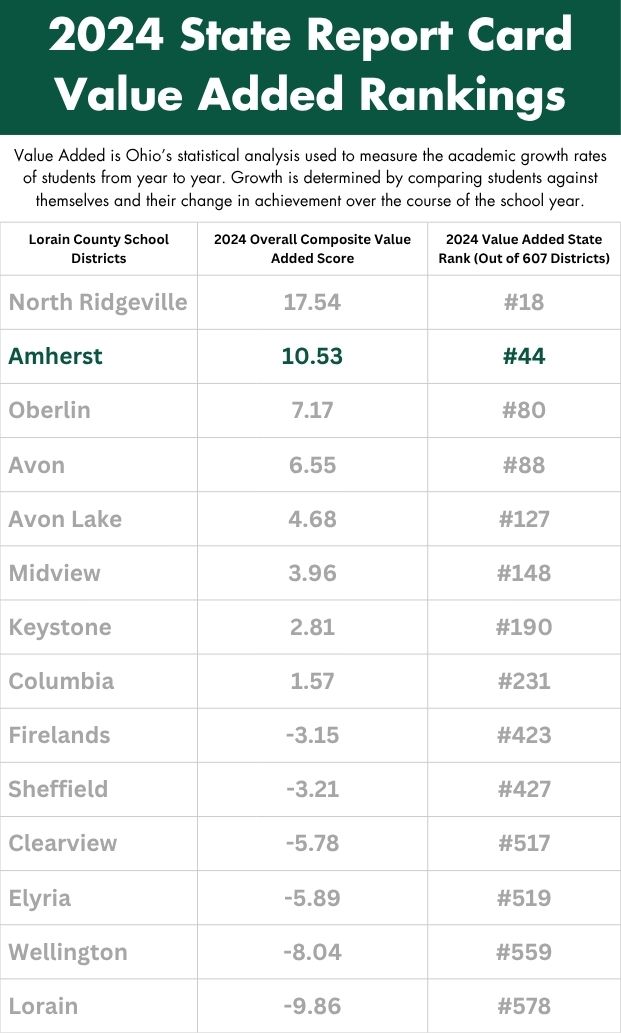
On the 2024 State Report Card, Amherst was in the top 8% of school districts on the state's Value Added measure of the report card. Value Added is Ohio’s statistical analysis used to measure the academic growth rates of students from year to year. Growth is determined by comparing students against themselves and their change in achievement over the course of the school year. Please see the comparison below to the rest of Lorain County.