1. What is on the May ballot for Amherst Schools?
The Amherst Board of Education placed Issue 1 on the May 5th election ballot to provide the district with funding to maintain day-to-day operations. It is the district’s second attempt at asking the Amherst community for additional operations. The last new operations levy was passed 2012.
2. What kind of levy is Issue 1?
Issue 1 is a 0.75% earned school district income tax levy (SDIT) and a 5-year operating levy. Operating levies provide school districts money to be used for day-to-day expenses such as staff salaries & benefits, supplies, curriculum, textbooks, academic programs, utilities, transportation, and wrap-around services.
3. What is the difference between May's Issue 1 and Issue 16 from last November?
November's Issue 16 was a request for a continuous 1.5% earned school district income tax to provide the school district with $10 million for operations. Issue 1 is a request to provide the school district with $5 million for operations and is only a 5-year term. Essentially, the request has been reduced from $10 million in November to $5 million in May.
4. How was the district able to reduce the levy from $10 million in November to $5 million in May?
ACTION STEP #1 - Reduction Plan
After the November levy failed, Amherst was placed in “Fiscal Precaution” by the Ohio Department of Education & Workforce due to projected operating deficits in our financial forecast. As a result, the district worked with ODEW to develop and implement a multi-year expenditure reduction plan required to eliminate the deficit. The ODEW Precautionary Plan requires total expenditure reductions of $13,264,733 between FY2026 and FY2029. This plan was approved by the Board of Education on December 15, 2026 and approved by ODEW on January 6, 2026.
ACTION STEP #2 - Negotiations
The Amherst Administrative Team and the Amherst Teachers Association (ATA) reached a tentative agreement on January 14, 2026 on a one-year labor agreement for the 2026–2027 school year. Under the terms of the agreement, teachers will receive a 0% increase on base salary for the 2026–2027 school year. In addition, the administration will also receive a 0% increase on base salary. The Amherst Administrative Team and the Ohio Association of Public School Employees Local #208 (OAPSE) are tentatively scheduled to begin negotiations on March 16, 2026.
The Board of Education, Administrative Team, Amherst Teachers Association (ATA), and Ohio Association of Public School Employees Local #208 (OAPSE) are working collaboratively to avoid further financial burden on the community while maintaining staffing stability as much as possible.
5. What were the expenditure cuts after the November levy failed?
In order to reduce expenditures by over $13 million, the district made devastating cuts to staffing and operations. Below are the FY26-FY29 reductions approved on February 23, 2026:
NON-PERSONNEL REDUCTIONS
Steele News Live Program
French Program
AJH Homemaking & Consumer Education Program
High School Busing (9-12)
$1 Million Reduction in Textbooks and Curriculum
18 Instructional Software Programs
Professional Development Programs
General Supplies and Programs
PERSONNEL REDUCTIONS (48 Positions)
1 Buildings and Grounds Supervisor
1 Special Education Coordinator
1 Social Worker Position
1 School Counselor Position
3 Spanish Positions
1 French Position
2 Science Positions
1 Steele News Live Position
1 Homemaking Consumer Ed Position
2 English/Language Arts Position (7-12)
1 Music Position
2 Technology Innovation Specialists
2 Literacy Coaches
2 Intervention Specialist Positions
1 Fifth Grade Positions
2 Fourth Grade Positions
2 Third Grade Positions
2 First Grade Positions
4 Bus Aide Positions
4 Bus Driver Positions
3 Part-Time Cleaners
4 Full-Time Cleaners
4 Monitors
1 Assistant Mechanic
6. How will the cuts impact Amherst students, staff, and families?
Following the failure of the November operating levy, the district was required to implement significant expenditure reductions rather than receive new operating revenue. While we listened to the community and made the necessary reductions, it is important to understand that these cuts have real and lasting impacts on students, staff, and families.
Student Support Services
Reductions in a Special Education Coordinator, Social Worker, School Counselor, and two Intervention Specialists directly affect the level of individualized support available to students. This means:
Increased caseloads for remaining support staff
Less immediate access to social-emotional support
Fewer intervention services for struggling learners
Greater strain on special education coordination and compliance
While services will continue, they will be delivered with fewer personnel, which can impact responsiveness and flexibility.
Academic Programming
Reductions in Elementary Spanish, French, Science, English/Language Arts, Music, Homemaking/Consumer Education, and Steele News Live reduce course offerings and instructional flexibility at the secondary level. This means:
Larger class sizes in some courses
Fewer elective options for students
Reduced exposure to world languages and enrichment programs
Limited flexibility in scheduling and individualized pathways
These reductions narrow opportunities for students and reduce the breadth of programming our community has historically valued.
Curriculum and Textbooks
Reducing textbook and curriculum expenditures by $1 million limits the district’s ability to adopt new instructional materials, refresh outdated resources, and fully align curriculum with updated standards. While core materials will remain in place, replacement cycles will be extended and fewer updates will occur.
Instructional Software Programs
The elimination of instructional software programs reduces digital learning supports available to students and teachers. These programs often provide intervention tools, enrichment extensions, progress monitoring, and personalized learning supports. Fewer digital tools means fewer supplemental supports for diverse learning needs.
Elementary Class Sizes
The reduction of one Fifth Grade, two Fourth Grade, two Third Grade, and two First Grade positions will result in increased class sizes at the elementary level. While we will work to balance classrooms thoughtfully, larger class sizes reduce individual attention and increase workload for teachers.
Literacy, Technology, and Innovation
The reduction of two Literacy Coaches and two Technology Innovation Specialists will reduce embedded instructional support for teachers. These positions provided professional development, curriculum alignment, and classroom-level coaching that directly strengthened reading instruction and technology integration. Without these roles, teachers will have fewer internal resources for instructional growth and innovation.
Transportation and Operations
The reductions of the Buildings and Grounds Supervisor, four Bus Drivers, four Bus Aides, three Part-Time Cleaners, four Full-Time Cleaners, two Secretaries, four Monitors, and one Assistant Mechanic will impact daily operations across the district. The elimination of high school transportation services shifts more responsibility to families for daily transportation. This may create challenges for families with multiple children, limited flexibility, or limited access to transportation. It may also impact student participation in before- or after-school activities. This means:
Adjusted transportation routes and longer ride times
No individualized transportation services
Reduced supervision coverage
Slower response times for maintenance or facility needs
Increased workload for office and custodial staff
These changes may not always be visible in a single moment, but they affect the overall efficiency of daily school operations.
7. If the May levy passes, will these cuts return?
NO. If Issue 1 passes, the revenue collected from the 5-year 0.75% earned school district income tax levy (SDIT) will only balance the budget enough to maintain the current reduced staff levels and eliminated programming, bussing, etc. The district attempted to maintain the 2025-2026 staffing levels and programming through Issue 16 in November but the levy failed. Unless the State of Ohio funds public schools appropriately, the district will either maintain the reduced staffing levels and programming through new local revenue or we will need more future cuts.
8. If the May levy fails, will there be more cuts?
YES. Even with the reductions already implemented and the negotiated agreement, the district still projects operating deficits in the coming years. Without new revenue, programming, staffing, and support services will continue to face cuts. Unless the State of Ohio funds public schools appropriately, the district only has two choices to maintain current operations - new local revenue or continuing expenditure cuts.
9. How will the transportation cuts affect students and families next year?
The Transportation Department was reduced by four bus drivers and four bus aides as part of the district-wide expenditure reductions. With four fewer buses in rotation, the district must reduce total daily ridership to align with available drivers and vehicles. Below are the ways in which we will reduce ridership for next school year:
1. The “Space Available” option for parents within the walking boundaries has been eliminated.
2. Transportation for high school students (grades 9-12) is not required by the state and has been eliminated. The district is still required to provide transportation to the Lorain County JVS.
3. Ohio school districts are required to transport any student living beyond a two mile radius from their school. We currently transport any student living beyond one mile from their school. The district may need to adjust the one mile radius to possibly one and a half or the required two mile radius.
Due to the actions stated above, the district will need to adjust bus routes, bus stops, and pick-up times for next school year. Final route configurations and rider assignments will not be determined for a few months. Based on those changes, the district may need to adjust building start and end times.
The district will provide updates on transportation changes within the next two months.
10. What is a school district earned income tax levy?
The school district income tax (SDIT) is levied at a percentage on the income of district residents or on the taxable income of an estate. Businesses do not pay SDIT; only residents of the district are required to pay SDIT. The advantage of SDIT for a school district is quite simple: because SDIT taxes income, not property, there is no millage reduction factor involved. The levy proceeds grow or decrease as residents’ incomes do.
11. Isn't the school district getting huge increases from last year's property reappraisals?
Property tax revenue, which makes up the largest share of school funding, is frozen at the amount approved by voters under House Bill 920 (1976). While most of the property tax revenue is frozen from growth, the school district does receive increases in property tax revenue from "inside millage". The Amherst Schools had 5.2 inside mills during reappraisal and the Lorain County Auditor's Office projected an "inside millage" revenue increase of approximately $1.2 million.
While the Amherst School District was hoping to reap the benefit of inside millage, two major events just erased that increase. First, Ohio is reducing our state funding by a projected $600,000-$800,000 this school year (July 1 - Governor's Budget). Second, the Lorain County Commissioners approved a measure to increase the homestead & owner-occupied property tax exemption, thereby reducing our local funding by over $840,000 (October 7).
The combined loss of state funding and county exemptions are projected to cut Amherst's funding by over $1.4 million per year!
12. How is the Amherst Exempted Village School District financed?
The majority of Amherst’s funding comes from local revenue. Amherst receives 43% of its funding from local taxes. Amherst receives an additional 39% of its funding from the State of Ohio, 11% from the federal government, and 7% from other revenue.
13. Is the State of Ohio providing enough revenue and support for Amherst?
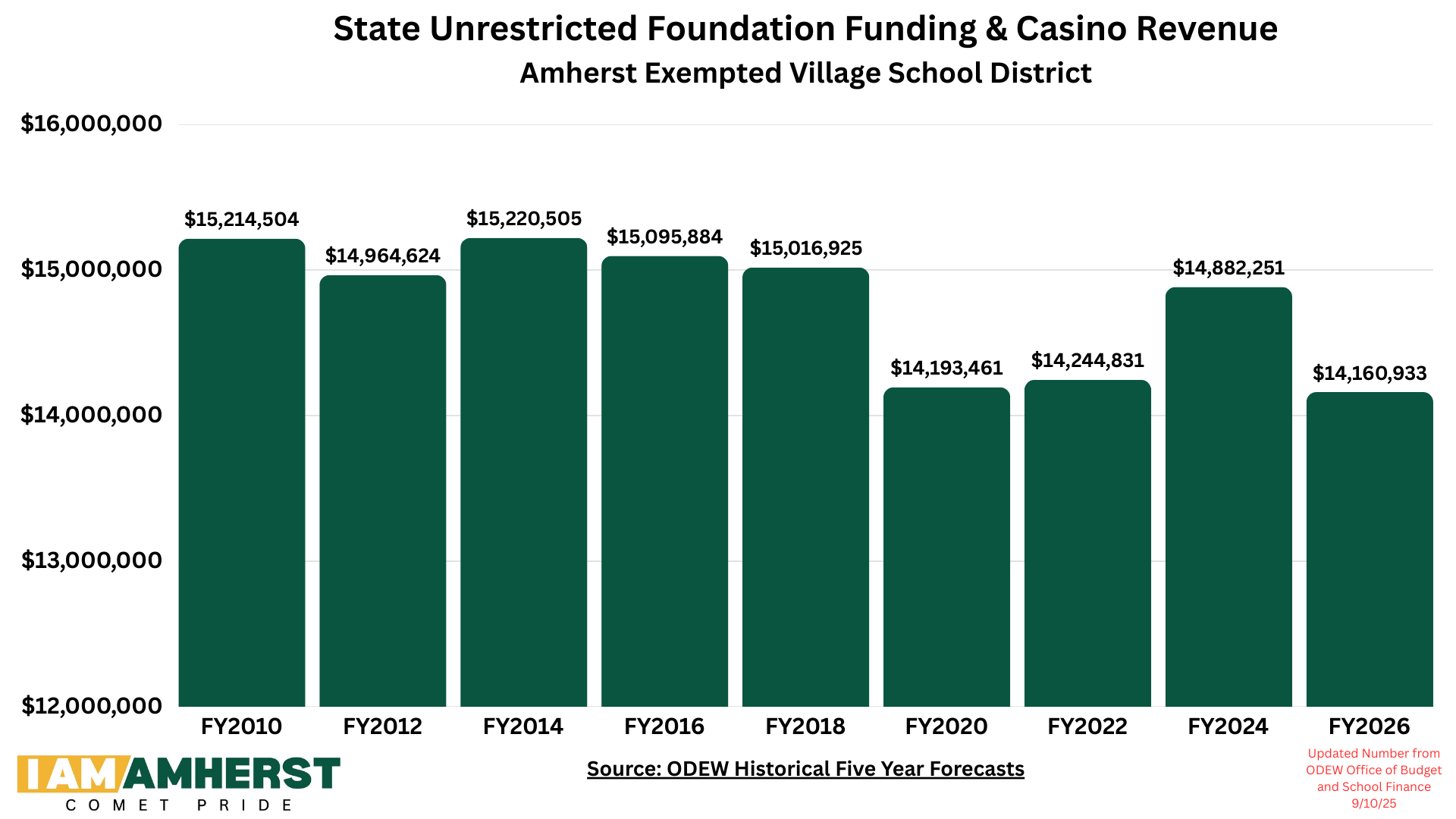
No. In FY2025, Amherst received $14,755,730 in state unrestricted foundation funding plus casino revenue from the State of Ohio to help fund our school district. In FY2026, Amherst is projected to only receive $14,160,933 in state unrestricted and casino funding - a reduction of about $600,000 dollars in one year. To provide context, in 2010, Amherst received $15,214,504 in state foundation funding. For the last 15 years, the State of Ohio’s foundation funding for the Amherst Exempted Village School District has steadily declined. Please see the graph below for more details.
14. How does Amherst compare to other school districts in regards to revenue?
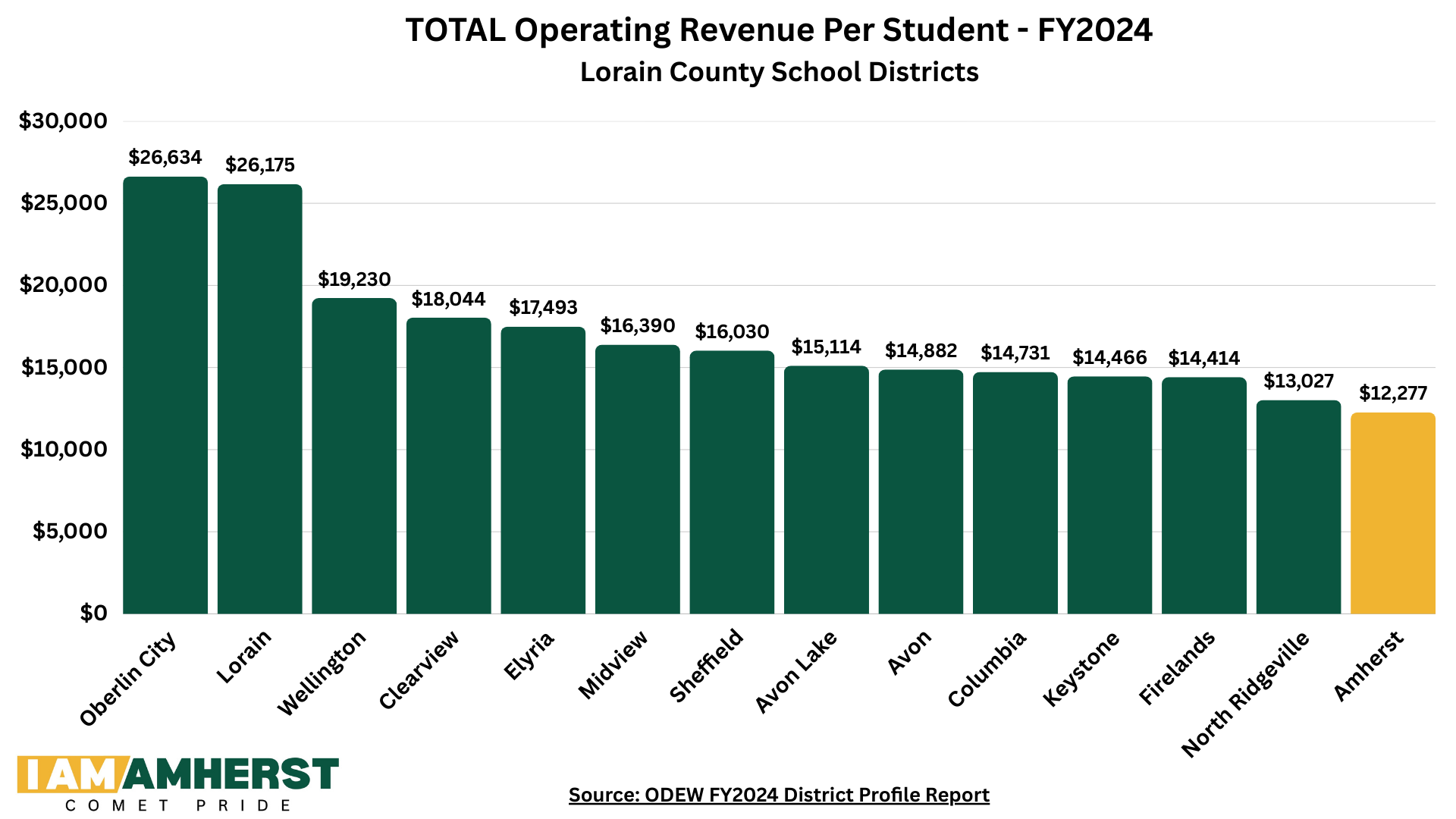
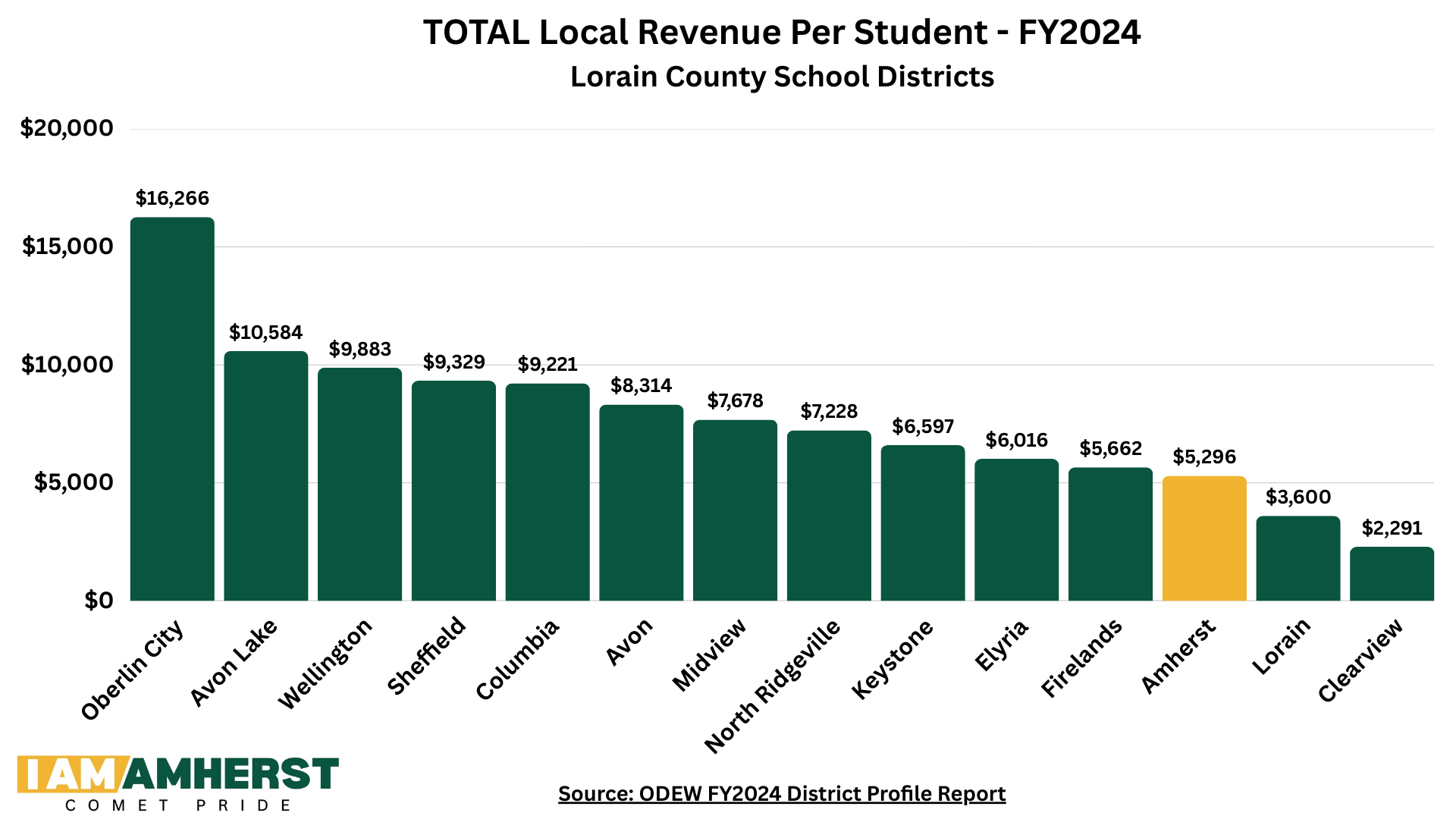
In 2024, Amherst received $5,296 per student from local revenue and $4,754 per student from state revenue. Amherst received $12,277 per student in total revenue which is the lowest amount in Lorain County and the second lowest amount in the State of Ohio. Out of 606 school districts in Ohio, the Amherst Exempted Village School District ranks 605th in total revenue per student. For comparison, Amherst received $12,227 per student, the state average was $18,168 per student, and the Ohio school district with the highest revenue received $44,246 per student. Please see the graphs below for more details.
15. How does Amherst compare to other school districts in regards to expenditures?
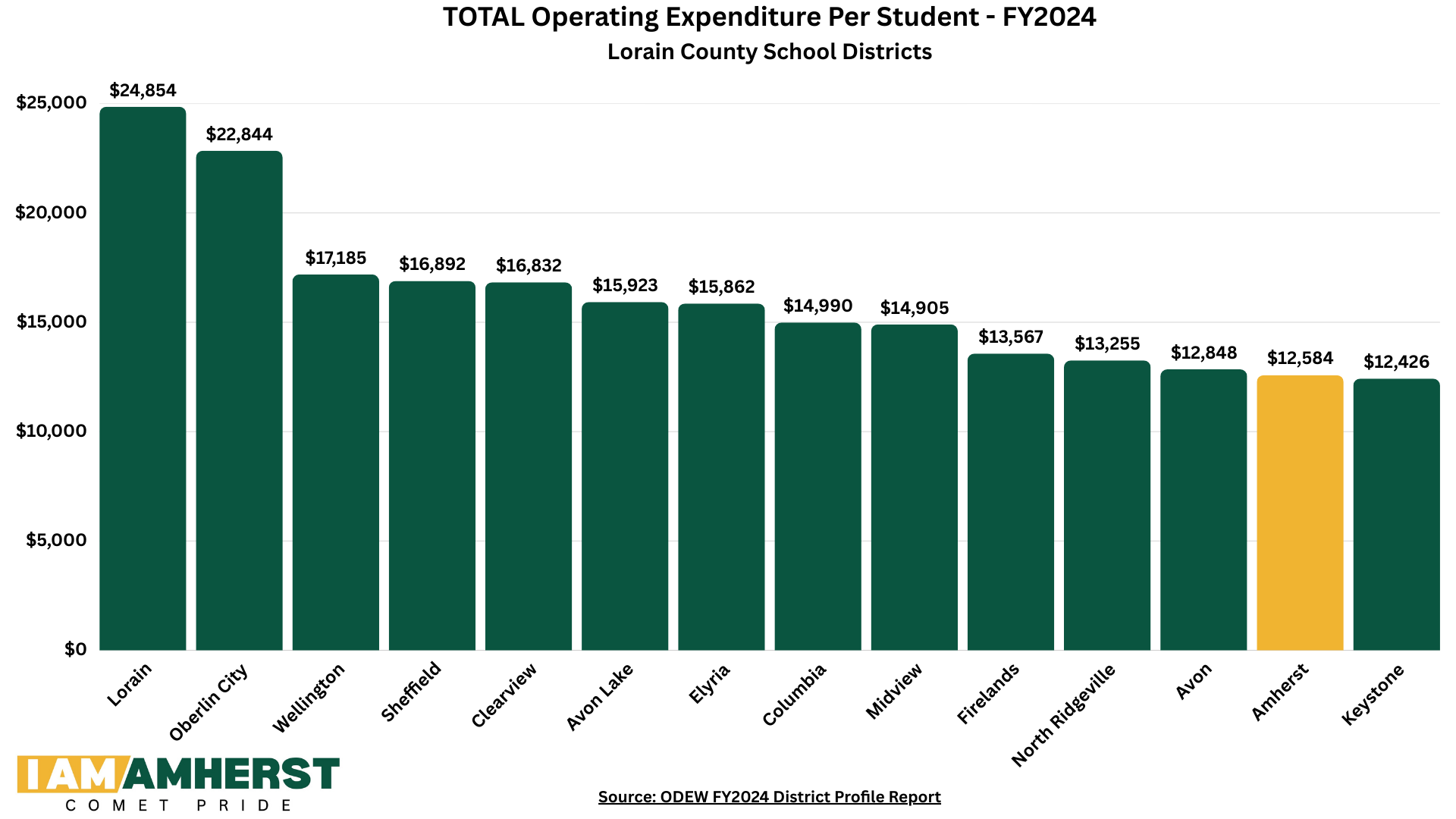
In 2024, Amherst spent $12,548 per student in total expenditures which is the second lowest amount in Lorain County. Out of 606 school districts in Ohio, the Amherst Exempted Village School District ranks 570th in total expenditures per student. For comparison, Amherst spent $12,548 per student, the state average was $16,311 per student, and the Ohio school district with the highest expenditures spent $37,449 per student. Please see the graph below for more details.
16. Does the district ever seek additional revenue to offset expenditures?
Yes. Over the last three years, the district has used almost $4 million in COVID relief grants to offset costs in personnel, supplies, technology, and purchased services. Amherst was the only school district in the state of Ohio to receive both the Comprehensive Literacy State Development grant worth $270,000 and the Each Child Reads grant worth $67,233 in the last three years. Amherst also received a competitive $1.6 million Ohio Career Technical Equipment grant to fund our state-of-the-art Robotics and Advanced Manufacturing program at Marion L. Steele High School. In addition to competitive grants, the Amherst Exempted Village School District also works with business partners, community partners, and private citizens to help fund special projects and initiatives through public and private donations. Recently, the Amherst Schools have received a $160,000 private donation to support the track renovation, $40,000 from the Amherst Schools Educational Foundation (ASEF) to create a new Comet Corner store, $25,000 from ASEF to fund a new Business & Entrepreneurship teacher, and recently signed a ten-year agreement with Spitzer Autoworld Amherst worth $25,000 per year for stadium naming rights (Spitzer Stadium). The Amherst Schools work very hard to find alternate revenue streams to offset costs!
17. Will new homes and previous communities with ending tax abatements provide more revenue in the future?
Yes. It is very difficult to predict the revenue from new homes but a new $250,000 home would generate about $2,000 of new tax revenue to the school district. Each new home can also bring new Amherst students which adds to our expenditures. As for homes with tax abatements, the City of Lorain has provided us a list of abated homes and their abatement schedule. Over the course of the next five years, we’ve identified 89 homes which will start providing school revenue. The total revenue from those 89 homes is about $81,000 per year once all 89 homes are in full collection by FY 2030.
18. Doesn't the Ohio Lottery help fund public schools in Ohio?
According to the Ohio Legislative Service Commission, lottery profits have never accounted for more than 17 percent of total state spending on education since its inception, and recently it has been around 12 percent. In practical terms, this means nearly 90 percent of state spending on schools comes from primarily income and sales taxes deposited into the General Revenue Fund.
Also, lottery profits are woven into the budget rather than stacked on top of it. For example, if lottery profits come in at $1.45 billion, that reduces the amount the state must draw from general tax revenue to reach its target. It does not automatically add $1.45 billion in new spending above and beyond what lawmakers have allocated for public education.
19. Who pays the school district earned income tax?
Any individual residing in the state of Ohio who lives in a school district that levies the tax will pay the SDIT. Non-residents of the school district are not subject to the tax, even if they work within the district’s boundaries. Corporations are also exempt from the SDIT.
20. Will the school district earned income tax be collected from the following sources?

21. Who collects the school district earned income tax?
The Ohio Department of Taxation collects the SDIT. All tax forms are filed with the Ohio Department of Taxation, and all taxes due are paid to the state. The Amherst Exempted Village School District will receive quarterly distributions from the State of Ohio.
22. How is the school district earned income tax collected?
The SDIT is collected in the same manner as the state income tax: through employer withholding, individual quarterly estimated payments, and annual returns. Employers are required to withhold the tax and submit payments to the state under the same rules and guidelines as they currently use to withhold the state income tax. Individuals subject to the tax are required to file an annual SDIT return.
23. Why did the Board of Education decide to place a school district earned income tax on the May ballot instead of a traditional property tax?
As Ohio school funding shifts increasingly to local taxpayers and as the legislature continues to attack property tax levies, there are several reasons why choosing an earned income tax levy over a traditional property tax levy in Ohio is more sustainable for our district. These include:
1. Exempts Retirement Income and Protects Seniors
Earned income tax levies only apply to wages and self-employment income—they do not tax pensions, Social Security, or investment income.
This structure protects residents on fixed incomes, such as retirees, who may already be struggling with rising property taxes. This is ideal in communities like Amherst that have a large senior population.
2. Income-Based, Not Asset-Based
A property tax is based on the value of a home, regardless of a person’s ability to pay.
An earned income tax is based on what people actually earn, which better reflects their current financial situation.
This can reduce the burden on those with high property values but low incomes (such as retired homeowners, farmers, etc.).
3. Grows with the Economy
As wages grow and more people are employed, earned income tax revenue can increase naturally, keeping pace with inflation and rising costs.
Property tax revenue, on the other hand, is often frozen or slow-growing due to Ohio’s tax laws (HB 920 limits inflationary increases on voted millage).
Economic growth in the community can help sustain school funding without placing additional levy requests on taxpayers.
4. Community Contributions
Home owners who have tax abatements and renters who would normally not pay a property tax will pay the earned income tax to help contribute to funding our schools
Those who earn more contribute more, while those with low or no earnings contribute less or nothing.
For working families, an income tax can be deducted from paychecks, avoiding large lump-sum bills like those that come with property taxes.
This can make it more manageable and predictable for household budgets.
5. More Sustainable for the District
Earned income tax levies can diversify a district’s revenue sources, reducing total dependence on volatile property values or housing development patterns.
This flexibility can be vital during economic shifts or real estate downturns.
24. How does Amherst compare to other Ohio school districts in academics?
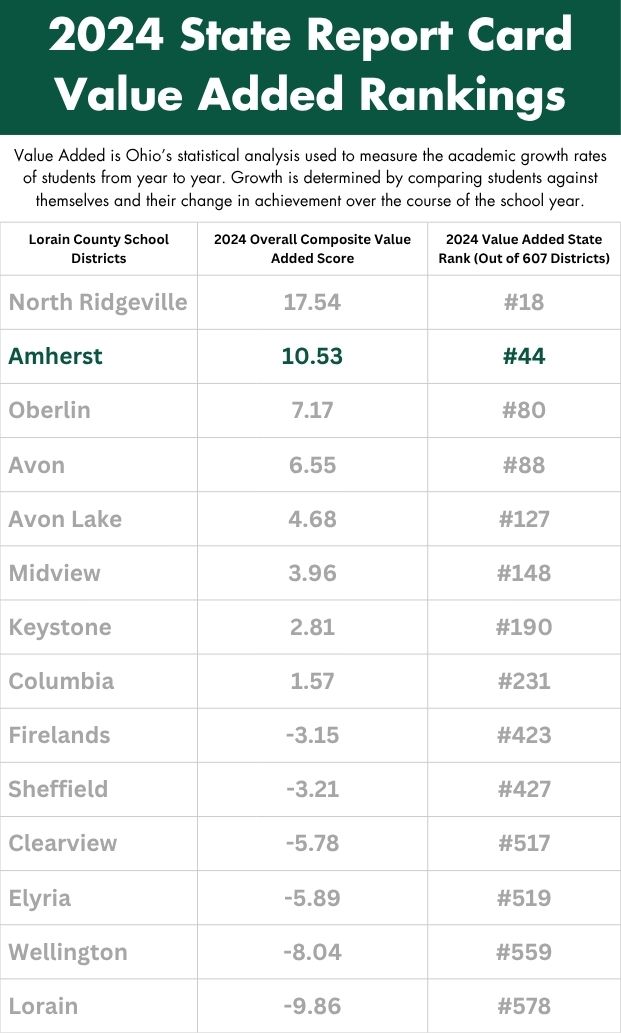
On last year's State Report Card, Amherst was in the top 8% of school districts on the state's Value Added measure of the report card. Value Added is Ohio’s statistical analysis used to measure the academic growth rates of students from year to year. Growth is determined by comparing students against themselves and their change in achievement over the course of the school year. Please see the comparison below to the rest of Lorain County.